
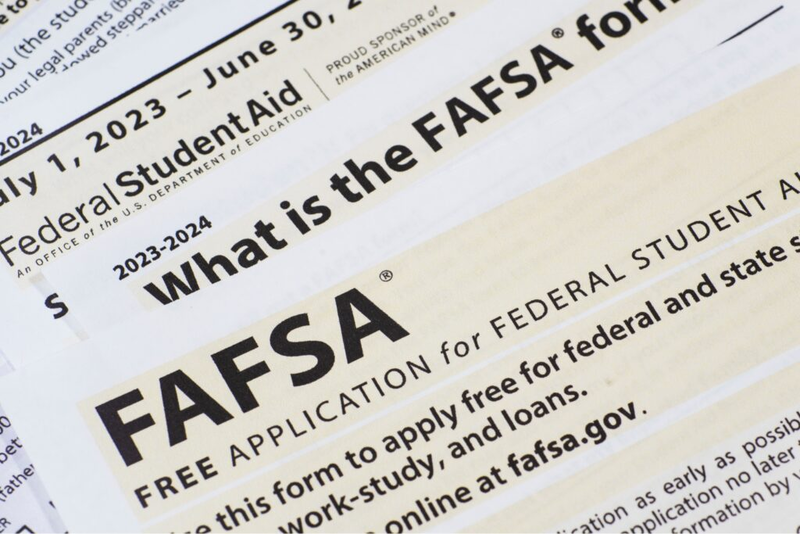
FAFSA Portal Debuts With Bugs And Delays, Frustrating Parents And Students Across The Country
Over the New Year weekend, the long-awaited Free Application for Federal Student Aid (FAFSA) portal opened, revealing a new simplified form. However, despite some improvements, there are still many bugs that need to be fixed, to the frustration of parents and students across the country, CNBC reported.
As part of a “soft launch,” the Department of Education has only made FAFSA available periodically, which means that most applicants for the 2024-25 academic year have not even been able to access the form. Mark Kantrowitz, an expert in higher education, spoke to CNBC about the delays.
“I am convinced that nobody has been able to submit the form. Congress required the FAFSA to be available before Jan. 1, 2024. They missed that deadline,” he said.
According to Kantrowitz, if the Department of Education manages to fix these complications soon, universities may still be able to administer financial aid packages by late March or early April. However, if these problems are not immediately addressed, the consequences could be substantial.
“Families will not be able to get financial aid offers in a timely manner. Already, students who applied early action or early decision do not have award offers,” he said. “It is a pretty big deal. We are talking about thousands of additional dollars that families will have to pay for college.”
The Department of Education has advised families to wait rather than panic about the ongoing situation, saying, “You will have ample time to fill out the form and do not need to rush to complete the form during the soft launch.” According to CNBC, even if students manage to submit the FAFSA form, schools won’t receive the necessary information until late January. Still, this has done little to quell applicants’ concerns.
The delay is not the only complication with FAFSA this year. FAFSA’s newest model is based on outdated consumer price index figures from 2020. Because of this, the Department of Education has failed to adjust for increased inflation rates, which could cause families to lose out on assistance. “In prior years, it wouldn’t matter all that much because inflation was low,” Kalman Chany, financial aid consultant and author of The Princeton Review’s Paying for College, told CNBC. “Given the high inflation in the past few years, the tables should be adjusted by a tad more than 18%.”
FAFSA has undergone a significant redesign following years of complaints and difficulties with functionality. The Department of Education has reduced the number of questions on the application from 108 to only 46. It has also altered how financial aid is distributed. Rather than rely on the expected family contribution (EFC) metric, FAFSA has instead adopted a new method – the Student Aid Index (SAI). With SAI, dependent students with separated parents must report the income of the parent who offers the most financial support, as opposed to the parent they live with the majority of the time. Furthermore, universities will determine aid eligibility using a case-by-case basis, meaning that families with multiple children in college will not automatically receive additional aid.
RELATED CONTENT: FAFSA To Undergo Dramatic Changes This Upcoming Cycle