
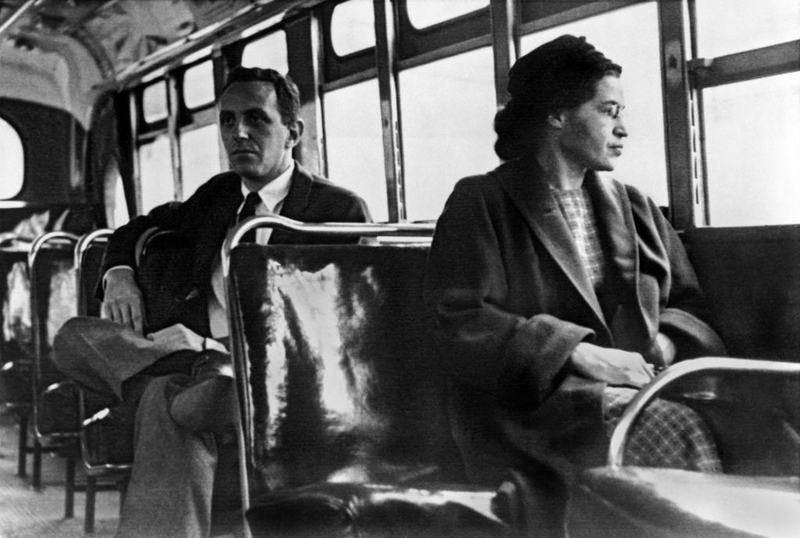
Remembering Rosa Parks’ Resilience And Resistance In The Face Of Racism
UPDATED: 8:15 a.m. ET, Feb. 4, 2022 —
Originally published: Dec. 1, 2017
While our elders like Rosa Parks deserve our love and admiration every day all day, it’s probably
Rosa Parks, who is befittingly called the “Mother of the Modern Day Civil Rights Movement” for sparking the Montgomery Bus Boycott, would have celebrated her 109th birthday on Friday.
Born Rosa Louise McCauley on Feb. 4, 1913, in Tuskegee, Alabama, the legendary civil rights icon who was arrested in 1955 for refusing to give her seat up to a white woman on a public bus remains a strong symbol of resilience and resistance in the face of racism.
It seems almost karmic that Parks’ birthday month coincides with Black History Month.
A special day today ..Rosa Parks Day
“You must never be fearful about what you are doing when it is right-I knew someone had to take the first step and I made up my mind not to move. Each person must live their life as a model for others” Rosa Parks – phenomenal woman pic.twitter.com/TcZjddViWC— Professor Jacqueline Dunkley-Bent OBE (@TeamCMidO) February 4, 2022
Parks’ signature move, simple in delivery but stellar in impact, represented a refusal to relinquish her seat to a white passenger when bus driver James F. Blake demanded that she do so in Montgomery, Alabama, on Dec. 1, 1955. Blacks were known as colored, and inferiority was the superior thought about African Americans at the time of Parks’ burgeoning resistance. She, like so many Black people, was tired of being resigned to second-class status because of racism.
December 1, 1955 — Rosa Parks was arrested after refusing to give up her seat to a white passenger in Alabama. pic.twitter.com/Fkqmfz5UWj
— MoorInfo (@MoorInformation) December 1, 2020
On that day, Parks’ resistance was right. Yet, the courageous woman, 42, was arrested and briefly locked up, handcuffed by the stigmatization of segregation.
#OnThisDay 65 years ago, Rosa Parks spoke out – 4 days later, the world began to listen. #MontgomeryBusBoycott #otd pic.twitter.com/UJ96hEbovJ
— Rosa Parks Museum (@RosaParksMuseum) December 1, 2020
Parks’ revolution was racialized and publicized. Threats and caveats alike were thrown her way, but proved futile.
1955: Rosa Parks refused to give up her seat on a Montgomery, Ala. city bus. https://t.co/gptsz8CDn1 pic.twitter.com/4watpqD8FA
— The New York Times Archives (@NYTArchives) December 1, 2017
The activist summed up her feelings about that heavily documented day in her “Rosa Parks: My Story” autobiography in 1992: “I was not tired physically, or no more tired than I usually was at the end of a working day. I was not old, although some people have an image of me as being old then. I was 42. No, the only tired I was, was tired of giving in.”
Don’t you know, talkin’ bout a revolution. It’s sounds like a whisper#1dicembre #RosaParks pic.twitter.com/71UCdUne59
— Carmine Valentino (@ValentinoC2014) December 1, 2017
Parks, the secretary of the Montgomery NAACP chapter at the time, was not the first woman to refuse to vacate her seat. Claudette Colvin, Susie McDonald, Mary Louise Smith and other women were arrested for their resistance of the segregated bus system. A small boycott snowballed into a major boycott that lasted more than 300 days, starving revenue for the Alabama buses operations.
On this date in history in 1955, Rosa Parks refused to sit in the back of a Montgomery, Alabama, bus, defying the South's segregationist laws. God bless her. #TheSimpleTruth pic.twitter.com/PZ66laoa07
— ♔𝓙𝓪𝓶𝓮𝓼 𝓣𝓱𝓮 𝓐𝓻𝓴𝓪𝓷𝓼𝓪𝔀𝔂𝓮𝓻♔ ジェームズ (@Scotty_2017) December 1, 2020
Colvin, Parks and the other female protesters, along with Rev. Dr. Martin Luther King Jr., in solidarity with one another, supported a major legal case, Browder V. Gayle, that caused a reversal in course pertaining to bus segregation in 1956. Black folks won the agency to sit in whatever seats they wanted, a right that should have been there’s from the start.
On December 21, 1956, Black bus riders in Montgomery were finally allowed to be seated on a first-come, first-serve basis. Rosa Parks and Dr. King were among the first passengers to board local buses that day. pic.twitter.com/8aUrRH2Ne5
— Legal Defense Fund (@NAACP_LDF) December 1, 2017
#OnThisDay in 1955, Rosa Parks was arrested in Montgomery, Alabama, after refusing to give up her bus seat to a white passenger… https://t.co/NGxedDAcym pic.twitter.com/H5Zwk0w9Dy
— HistoryExtra (@HistoryExtra) December 1, 2017
Parks, who died in 2005 at the age of 92 in Detroit, Michigan, will forever be remembered for her role in the revolution in Montgomery.
Like Rosa Parks, mother of the civil rights movement, let's be FEARLESS in our fight to end gun violence. pic.twitter.com/rqjOJQZx6k
— Moms Demand Action (@MomsDemand) December 1, 2017
African Americans, including Barack Obama, have admired the intrepid Parks.
*Takes my breath away!*
Be still my heart.On this day, Rosa Parks refused to give up her seat.
Photo: President Obama sits on the Rosa Parks bus at the Henry Ford Museum in Dearborn, MI pic.twitter.com/UarPcnTa6d— Sweet Home Allegra (@YMBBastepaway) December 1, 2017
Bus seats are still posthumously reserved for the activist even to this day.
Milwaukee transit buses to honor Rosa Parks Friday: https://t.co/nopYxPdSPD pic.twitter.com/XvdQSg7DWe
— TMJ4 News (@tmj4) November 30, 2017
SEE ALSO:
Rosa Parks’ Historic Home To Return To The US
Who Knew? Besides Being A Civil Rights Icon, Rosa Parks Was Also A Great Cook
[ione_media_gallery id="3835232" overlay="true"]