
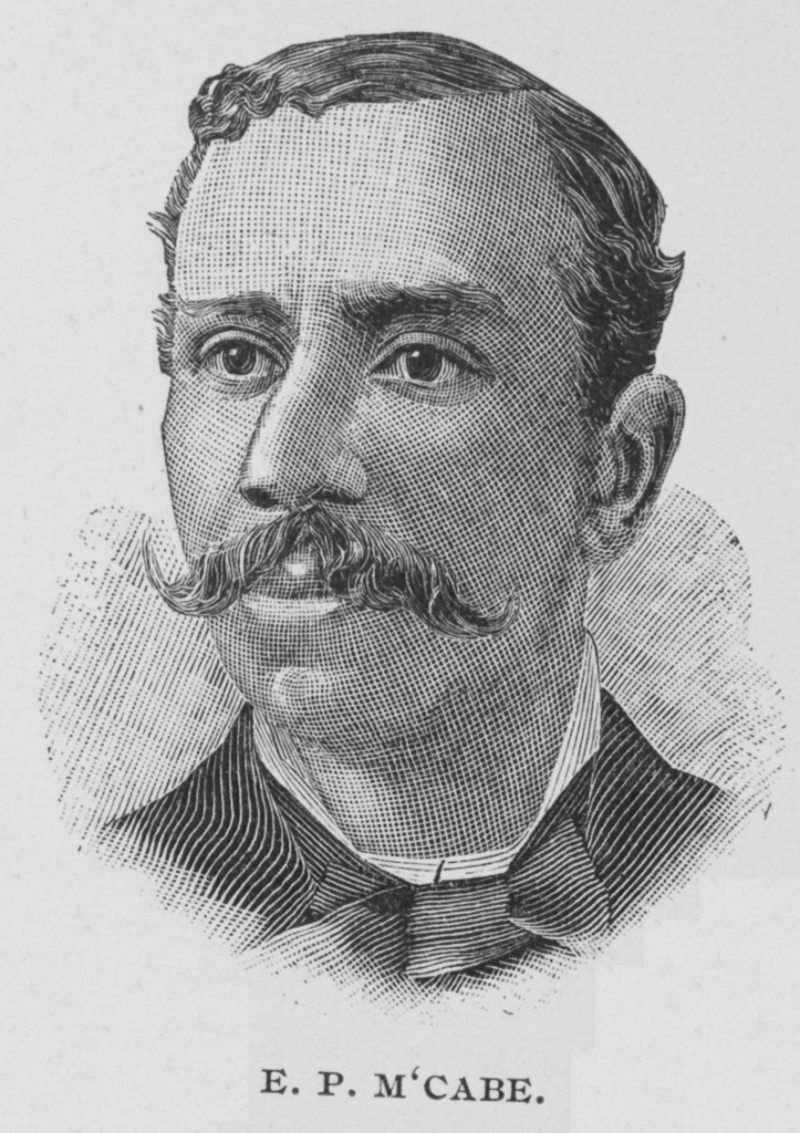
New Biography Illuminates Edward P. McCabe, The Visionary Politician Who Dreamed Of An All-Black State In Oklahoma
If you’ve never heard of Edward P. McCabe, there’s likely a good reason for that. Even though he is a notable figure in history, among the first Black Americans to be elected to political office and one of three Black founders of the town of Langston, Oklahoma as well the HBCU that bears the town’s name, Langston University, McCabe was also considered something of a pariah, even in his day.
According to Caleb Gayle, the author of a recently released biography about McCabe, “Black Moses: A Saga of Ambition and the Fight for a Black State,” McCabe’s effort to establish a Black state in Oklahoma exists as a cautionary tale in regards to utilizing colonization to benefit Black people.
“The reason I was so interested in him wasn’t because he was perfect, but because he was deeply flawed. His rationale was deeply flawed and you could see from the start that he was going to fail,” Gayle told Northeastern University in July.
He continued, “As Black leaders talking to Black people in a predominantly Black state, that’s what he wanted to do, but in so doing, he was exacting the same experiences of colonization on his own people. They were actively trying to colonize Oklahoma, but on behalf of Black people.”
To that end, McCabe, a Republican, petitioned then-president of the United States Benjamin Harrison, also a Republican, to allow him to provide a solution to “the Negro problem” by appointing him the governor of the Oklahoma Territory, but Harrison turned him down.
McCabe, undeterred by Harrison’s rejection of his plan, still traveled to Oklahoma on his own accord in 1890, and found an area in a state of flux as it tended to attract poor white immigrants and was also the home of indigenous peoples who had been driven off their ancestral lands.
McCabe’s idealistic, yet flawed approach stemmed from his association with the now forgotten “Exodusters” movement, principally concerned with helping newly freed formerly enslaved people living in the South escape the region.
McCabe may have learned the wrong lessons in trying to use Capitalism to obtain liberation, and as Gayle notes in his account, the work of colonization cannot simply be turned on other colonized people who have been similarly crushed underneath the heel of the American empire because one feels that the country owes your people a debt.
In actuality, the empire owes both Black people and Native Americans a debt, a bill of reparations it can never fully repay.
As Gayle notes in the book, “Salvation was collective, because it was for a coherent group: Black people in the South. It was terrestrial because they planned to find salvation in the real land of Kansas. As Reconstruction collapsed, Black people had to act — and quickly.”
Unfortunately for McCabe and his compatriots, in 1891, Harrison and the GOP allowed white settlers to make a run on the land in Oklahoma, which led to McCabe recognizing that his “hope in the Republican Party was evaporating. His frustration over the misalignment between his desired pace of progress and that of his white Republican colleagues had been simmering in the background.”
In the end, McCabe’s death in poverty and relative obscurity dovetails with the 1921 Tulsa Race Massacre, McCabe’s death precedes the massacre by one year, but the explosive destruction of Black Wall Street at the hands of whites in Tulsa (with the assistance of the American government) illustrates the paradox at the root of McCabe’s effort to create a Black state: even if Black people were given latitude to create their own table, white people would just invent a fantasy, a pretext to destroy the house it sits in.
So far, Gayle’s biography has received rave reviews, according to book review aggregation site Book Marks.
Per Adam Goudsouzia’s review for The Washington Post, the success of Gayle’s biography lies in the questions it forces the reader to ask themselves.
“Black Moses never exposes McCabe’s inner motivations, his actual personality, his fleshed-out ideology, his doubts and fears, and hopes and satisfactions. He stays behind a mask. But if the book cannot achieve all the aims of a traditional biography, it illuminates the world of Black politics in the age of westward migration, with all its aspirations, complications, and frustrations,” Goudsouzia notes.
He continued, “His dreams emerged from ‘a battle of ideas for how Black people might make their way in America.’ Could they secure and practice democratic rights in an integrated society? Or was White supremacy so intense, so intractable, that it demanded Black people eventually separate themselves?”
RELATED CONTENT: Students Request ‘Angel Of Greenwood’ After Tulsa Massacre Book Rejected, Receive Free Copies From Author