

Colorado receiver Travis Hunter emerges as historic Heisman Trophy contender
If I were casting a vote this minute for the Heisman Trophy, the winner would be Colorado’s wide receiver/defensive back Travis Hunter.
Hands down.
Quarterback Jalen Milroe and receiver Ryan Williams have played impressively for Alabama and Boise State running back Ashton Jeanty is a quality dark horse.
But no player in college football — perhaps in college football history — is doing what Hunter is doing: playing at an exceptional level on offense and defense. In a sport where injuries are 100% certain, Hunter is playing nearly every snap of every game — and Colorado needs him to extraordinary double duty if it hopes to win. At age 21, Hunter possesses all the qualities that you want not only in a star player but in the leadership of a team: stamina, talent and apparently unyielding dedication and discipline when it comes to taking care of his body.
What distinguishes Hunter in this year’s voting is his high-level versatility. As talented as Milroe, Williams and Jeanty are, they each play one position. Hunter’s versatility is his Heisman ticket.
“That’s extremely important. It’s probably more important than any other statistic,” Desmond Howard said during a recent phone interview.
Howard is a Heisman trophy voter; more important, he is a Heisman Trophy winner. During his Heisman season at Michigan in 1991, Howard multitasked as a wide receiver and devastating kick returner. Howard won the award at age 21. Now, at age 54, he is a Heisman voter and an analyst for College GameDay on ESPN.
Since winning the award nearly 33 years ago, Howard said his view of the award and his criteria for who he votes for have evolved.
“What I look for in a Heisman candidate is someone who is unique or who is doing unique things,” Howard said. “Hunter checks that box. He is doing something that is very rare and very unique.”

David Zalubowski/AP Photo
As a kid growing up in Cleveland, Howard’s role model was running back Tony Dorsett of the Dallas Cowboys. Howard was a running back throughout his high school career.
“I loved the Dallas Cowboys as a kid, and I played running back all through my career,” Howard said. “From peewee football until I got to Michigan, I was a tailback. My whole thing was that I wanted to be like Tony Dorsett. I knew he won the Heisman, but my goal and aspiration was that I wanted to be an NFL player like Tony Dorsett.”
After he left Michigan, Howard spent 11 seasons in the NFL, mostly on special teams. The highlight of his career was reaching Super Bowl XXXI with the Green Bay Packers and being named Super Bowl MVP in 1997.
I asked Howard how being named Super Bowl MVP compared with winning the Heisman.
It did not.
“Anyone who picks up a football as a child and plays a sport ultimately wants to play in the NFL, and if you have dreams and aspirations of playing in the NFL, you want to win a Super Bowl,” he said. “In this sport it gets no bigger than the Super Bowl. That’s the top of the mountain. To be crowned the most valuable player at the top of that mountain is as good as it gets in this sport.
“The Heisman is great, but people don’t pick up football thinking I want to win the Heisman. They pick up the football thinking I want to play in the NFL.”
Of course, none of this diminishes the accomplishments of Hunter, who is an amazing college football player and is doing it in a way that has not been done since the early 1950s, when single-platoon college players routinely played offense and defense.
As an analyst, Howard gets to see some of the nation’s greatest college players and has a clear understanding of all the factors that go into winning the award. Talent, of course, but exposure plays a significant role in the process, which is why Hunter’s play is so exceptional.
I first saw Hunter as a freshman at historically Black Jackson State, where he became coach Deion Sanders’ first major recruit. Hunter made history by becoming the highest-ranked prospect to commit to an FCS school. Hunter played both ways and typically the doubters said he wouldn’t be able to replicate his feats on a larger scale. Last year, Hunter played offense and defense in the Pac-12 and this year he’s making his Heisman push at Colorado in the Big 12.
The reality is that had Hunter not performed on a larger stage, his Heisman hopes likely would have faded, even though he’s essentially doing the same thing at Colorado that he did at Jackson State.
“Playing at a high-profile program that’s on national TV a lot matters,” Howard said. “It helps because it gives you more exposure, it gives you more notoriety. If your team is winning, ESPN is going to talk about you more, you’re going to have more highlights on SportsCenter.”
Boise State’s Jeanty is a prime example of the exposure deficit. He is clearly a talented runner, but lacks the exposure of the SEC, the Big Ten and even the Big 12.
“They have a winning record, but they are not Ohio State,” Howard said. “If he was at Michigan, we would be talking about him like Travis or probably like Ryan Williams. If he was at a winning, popular program like that, then he would be getting more attention.’’
Howard said that, as a voter, one of his goals is to bring light to players such as Jeanty, who deserve wider recognition “because their talent is unique and rare.”
If Jeanty rushes for 155 yards this week, he will become the fifth college player to reach 1,000 yards in five games. “The crazy thing is that the kid had 127 yards against someone [Portland State] this season, but he sat out the whole second half,” Howard said.
I’ve often said that this is a significant season for Sanders to prove that he can make Colorado a winning program. Howard said he believes it’s less important for Hunter’s Heisman prospects for Colorado to win.
“The record is not as important as the talent,” he said. “You can only control what you can control but the talent is the talent.”

David Zalubowski/AP Photo
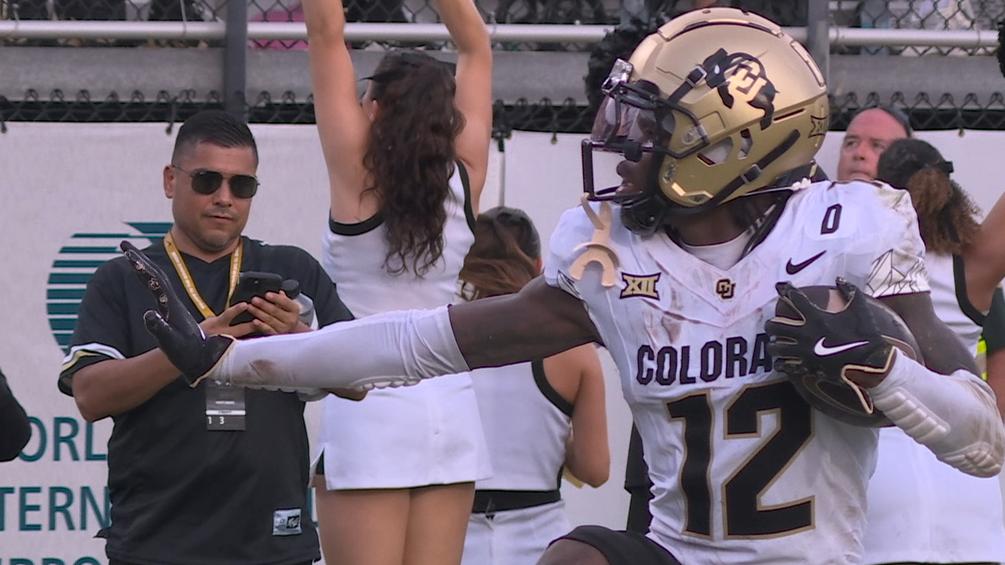
The other quality both Howard and I have admired about Hunter was that in a program built around Sanders’ flash and swagger, Hunter has remained reserved and under the radar. That is, until Sept. 28 in a game against the University of Central Florida.
After Hunter made an exceptional diving interception, he leaped up, ran a few yards and struck the Heisman poise. Whether Hunter knew it or not, he was paying homage to Howard, who more or less invented the Heisman touchdown pose in November 1991. After scoring on a 93-yard punt return against Ohio State, Howard struck the Heisman pose in the end zone.
I asked Howard what he thought about Hunter’s gesture. Hunter has not spoken openly about the Heisman race. “Obviously it’s on the young man’s mind,” Howard said. “And now that you have expressed this to the college football world, the onus is on you to back it up every time you get on that field. We’ll see.”
So far, Hunter has delivered.
Hunter plays nearly every snap in every game. As a receiver, he has 46 receptions — third among FBS receivers — for 561 yards (fifth), six touchdowns (third) and a 12.2 yards per catch average. On defense, Hunter has 16 tackles, a forced fumble, two interceptions and three pass breakups.
But here is what separates Hunter from his Heisman competitors: He has played 620 total snaps — 300 on offense, 320 on defense — through five weeks of the 2024 college football season. That’s an average of 124 snaps per game.
Hunter has recorded both a touchdown and interception in each of Colorado’s last two games. The last time that happened was in 2007 when Aqib Talib accomplished the feat while playing at the University of Kansas primarily as a defensive back, though he played some wide receiver. Talib played 12 NFL seasons as a defensive back.
He is a Travis Hunter fan.
“I had the privilege of playing defense and offense and there was no way I was playing every play of offense,” Talib said during a phone interview earlier this week. “I only went in for maybe four or five plays if that a game. I was like a specialist — they put me in, threw me the ball.”
Unlike Hunter, who splits his time nearly equally between offensive and defense, Talib was more or less a novelty.
“I definitely wouldn’t have been able to do it every play because the stamina just wouldn’t have been there. I couldn’t have done it,” Talib said. “And at a high level like that, I couldn’t have done it. I may could have played more than three to five plays. But this guy’s playing every snap. He’s a receiver, full-time receiver, and a full-time defensive back. That’s unicornlike. And that’s something super-special in my opinion.”
What impresses Talib is Hunter’s dedication to taking care of his body.
“It’s just special to have your body in that kind of shape to be able to play the entire game,” he said. “You got to have a different type of discipline about yourself. Whatever it is, is hard to have that discipline to be sleeping at 9 p.m. and help your body with that energy and eating right. Travis is doing something right. Coming off the field, I used to be so tired. I can’t imagine going right back in and then going right back into defense and playing at such a high level like he is. I think he’s changing the game before our eyes.”
Talib, who coaches 7-on-7 football in Plano, Texas, and also coaches high school, believes that a younger generation of players will begin to play both ways because of Hunter.
“I’m telling you I’m around the kids so much. That’s how I’m seeing the evolution of it. We got a kid at our high school who starts at corner, and he played 50% of the plays at receiver. But that’s how I’m seeing the evolution of the game. It’s going to become second nature to them. My son is on our 12-year-old team. He starts at cornerback and plays wide receiver. He played the entire game. He’s one of the few kids who don’t come out the game.
“I can just see the game changing before our eyes. Kids always want to do what they favorite players do, and Travis Hunter is a lot of their favorite player.”
Talib believes that Hunter can continue to play both ways in the NFL.
“I think we clearly see he’s good enough to do it,” Talib said. “It’s about is your body going to be able to handle it. If his body can handle it and hold up in college, I don’t see why it can’t in the NFL. I think he’s going to be one of the first guys to get to the NFL and play 85% of the snaps of the entire game.”

Phelan M. Ebenhack/AP Photo
But it’s only October. Colorado has seven more regular-season games to play, then hopes to reach the conference championship game and possibly a bowl game. There is a long way to go.
For now, Howard is sold on Hunter and two other candidates.
“If I had to fill out a ballot today those would be my three,” he said. “Williams, Hunter and Jeanty.”
Of the three, Hunter faces the greatest challenges.
“I think the biggest challenge is to be consistent and sustain the level of play that he’s at right now,” Howard said. “You don’t want to win the Heisman in September. There’s a lot of Heisman Trophy winners killing it in September, but can you sustain that level of play throughout the whole season? That’s the key.
“Make sure at the end of the season you’re able to finish strong, because people really remember the things you do in December.”
When he signed with Jackson State in 2013, Hunter became the highest-ranked recruit to sign with an HBCU program. I’m pulling for Hunter to make history again when he becomes the first former HBCU player to win the Heisman.